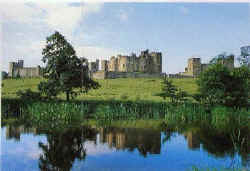
The Cradle of English Celtic Christianity.
Only about 30 to 40 miles north of Beggars Roost lies the island of Lindisfarne, more
commonly known as Holy Island. The island can be reached by car when the tide is
right.
Lindisfarne was given to St. Aidan in AD 635 by Oswald the Christian King of
Northumbria,
and from here Aidan together with the might of Oswald, who was followed by his son Oswin,
began his mission which earned the region the title of the 'Cradle of Christianity'. Not
only did they spread the gospel across the region but far down into England having to
bravely contest paganism against the kings of the south and Wales such as Pendragon. The
famous Lindisfarne Gospels were begun here in the 7th Century. St. Cuthbert
(whose remains
are interred in Durham Cathedral) was greatly influenced by Aidan and carried on the
tradition from Lindisfarne although for some time when appointed Bishop of Hexham he lived
elsewhere but returned as quickly as possible to his beloved island monastery.
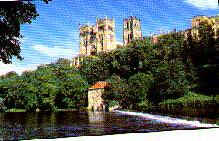
Durham Cathedral
|
In 664 Cuthbert signed the Treaty of Whitby with emissaries of the
Church of Rome which agreed that the Northumbria Church should follow the Rule of Rome
rather than Celtic Orders. Thus the original Church of England was subject to Rome until
Henry reversed things many centuries later. There are many many churches in the area
dating back to those Saxon times. there is St. Peter's at Monkwearmouth where the
Venerable Bede founded the Monastery in 674. The original entrance to the church is still
in situe. In Hexham is the abbey which was originally founded by St. Wilfrid in
674 and in nearby Corbridge, only 6 miles from Beggars Roost, is the church of St. Andrew
which was consecrated in 676. The area simply abounds with historic churches of the Saxon
and later eras.
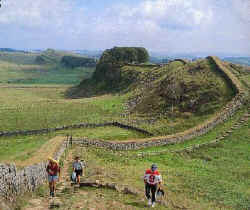
Hadrian's Wall Country.
|
Even before the time of St Aidan the Emperor Hadrian built the magificent Roman Wall
which strides for 73 miles across the hills and valleys of Northumberland from the Solway
to the Tyne to keep out the marauding Scots. To this day you can still walk
on many miles of this magnificent monument to Roman achievement. As the Romans occupied
the country from around AD 50 to AD 450 the many well excavated sites of camps and forts
that you can visit are virtually 2000 years old. Stretching north to the Cheviot Hills and
the Scottish Border covering almost 400 square miles of wonderful moorland, and coastal
stretches is the National Park of Northumberland.
Susan Brinkman
from Berlin
visits the
Healing Centre
|
Then south through the County Market Town of Hexham and the North Pennines stretching
from the coastlands of County Durham, through Northumberland and the Lake District to the
western coast of Cumbria is the country's most recent officially nominated Area of
Outstanding Natural Beauty. The main rivers of the region, the Tyne, the Wear, the Tees
and the Derwent spring up from the upper central highlands of this area. There are
moorlands, wooded valleys and unspoiled little villages. Castles, Great Halls and Houses,
Pele Towers (fortified towers) are scattered in profusion around the area.